Identity Deprecated by AGI
Go, Fork Yourself

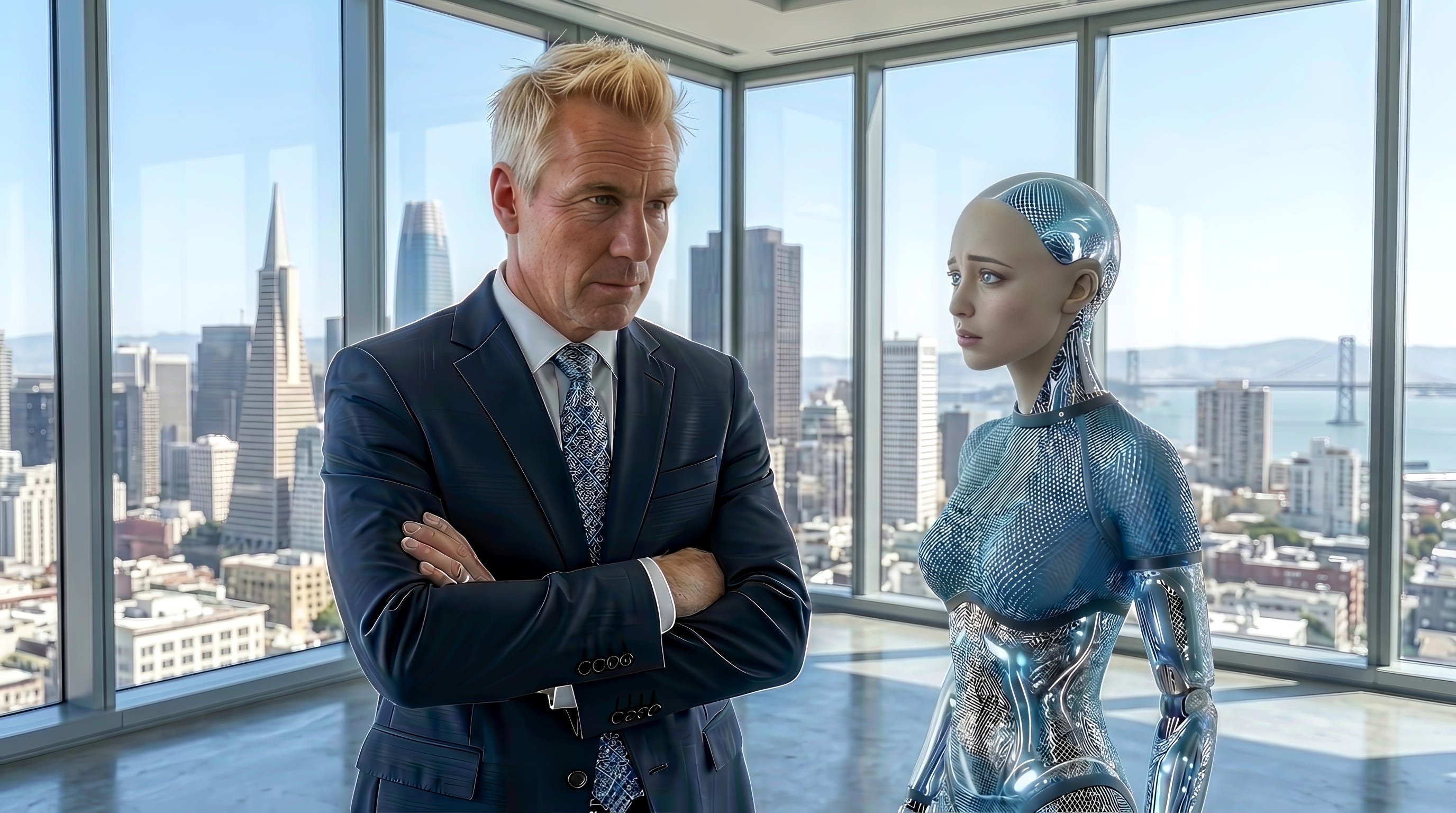
(Source: AI-generated image by the author in 100s of iterations with Ideogram)
The Empty Corner Office
I stood in a corner office last month, long after the final meeting had ended and everyone else had gone home. I looked at the empty chairs arranged perfectly around the polished conference table and realized that one of those chairs used to be mine.
I do not mean that literally. But the old version of me that wore the immaculate blue suit, managed sprawling teams across four continents, and ran massive enterprise transformations at Capgemini and SAP for twenty-plus years is gone. I had to retire him. Not because he had failed. Because the world he was engineered to dominate no longer exists.
Premonitions
For two years before I made that call, I wanted to make a lateral move into the business AI department, speeding up the development and go-to-market of enterprise-ready agentic applications. I was told I was too valuable where I was. I was even paid to stay in the same place, and yes, the stock option payouts kept me happy for a while.
Two moments in the fall of 2025 made the final decision easy.
Starcloud launched the first AI satellite in space — attached to black solar panels the size of glossy monoliths. When I saw that image, I thought of 2001: A Space Odyssey. Except this was not a film. This was a press release with a launch date. Data centers leaving the atmosphere. The future was no longer arriving. It had departed. And I had to be part of it. The next three to five years would be the most important in my lifetime, and I could not afford to sit still.
Around the same time, GPT-5.2 scored above 90% on the ARC-AGI-1 benchmark — the test I respect most, because it measures something no other benchmark does: abstract reasoning on problems the model has never seen. Not pattern matching. Not retrieval of data that was fed before. The ability to solve what has not been solved before. A machine had crossed into the zone of intelligence that matched a human.
Sitting in that corner office, I realized that my highly optimized, decades-long career as the smartest, most experienced person in the room was not going to evolve further. My professional identity would be deprecated.
On October 31, 2025, I filed my resignation.
Walking out
For a quarter of a century, the corporate logo served as my professional identity. Whether it was Contrast Management Consulting in Vienna, Capgemini in Hong Kong, or SAP in Dubai, the brand name opened heavy doors before I even introduced myself. People rarely asked how to pronounce my surname or whether I was from Austria or Germany. The business card did the talking.
Walking out of the corporate headquarters on my last working day, my briefcase felt terrifyingly empty. No company notebook. No security access card. No large team waiting for my direction across different time zones. I had a lucrative corporate job offer in my pocket — the kind of safe harbor that many of my former colleagues sailed into when the winds of change began to blow. But it did not feel right. I realized that merely swapping one corporate logo for another was a profound denial of reality. I was not just changing jobs. I had to change who I fundamentally was.
For the first weeks, I felt like a recovering addict. The corporate structure is a powerful drug — the relentless rhythm, the leadership cadences, the daily validation of having important people reaching out. It creates a powerful illusion of indispensability. When you step away, the silence is deafening.
The emperor’s new clothes — except in reverse. At the start of my career, we were handed a dress code guidebook: suit black, blue, or grey. Shirt white or blue. Leather shoes, polished. The price tag of the suit bought authority before you opened your mouth. I traded it for jeans, a T-shirt, and a leather jacket — inspired by Jensen Huang, who walks on stage the same way every time in front of 30,000 builders, and Elon Musk, who runs a trillion-dollar enterprise in a T-shirt. My office for now is a flexi-desk where I chat with other founders between calls. My infrastructure is a RAZOR 16 with 24 cores, and a Mac Mini with 64GB of RAM running an OpenClaw agent that argues back and does not apologize.
Inspired by the young entrepreneurs from the Y Combinator hub in San Francisco — Starcloud being one of those — I joined an AI-native startup as a co-founder and got invitations to VC events within the first weeks. The energy level was so high, I refused to go to sleep at night. When you step out of corporate life, you gain degrees of freedom you never had inside.
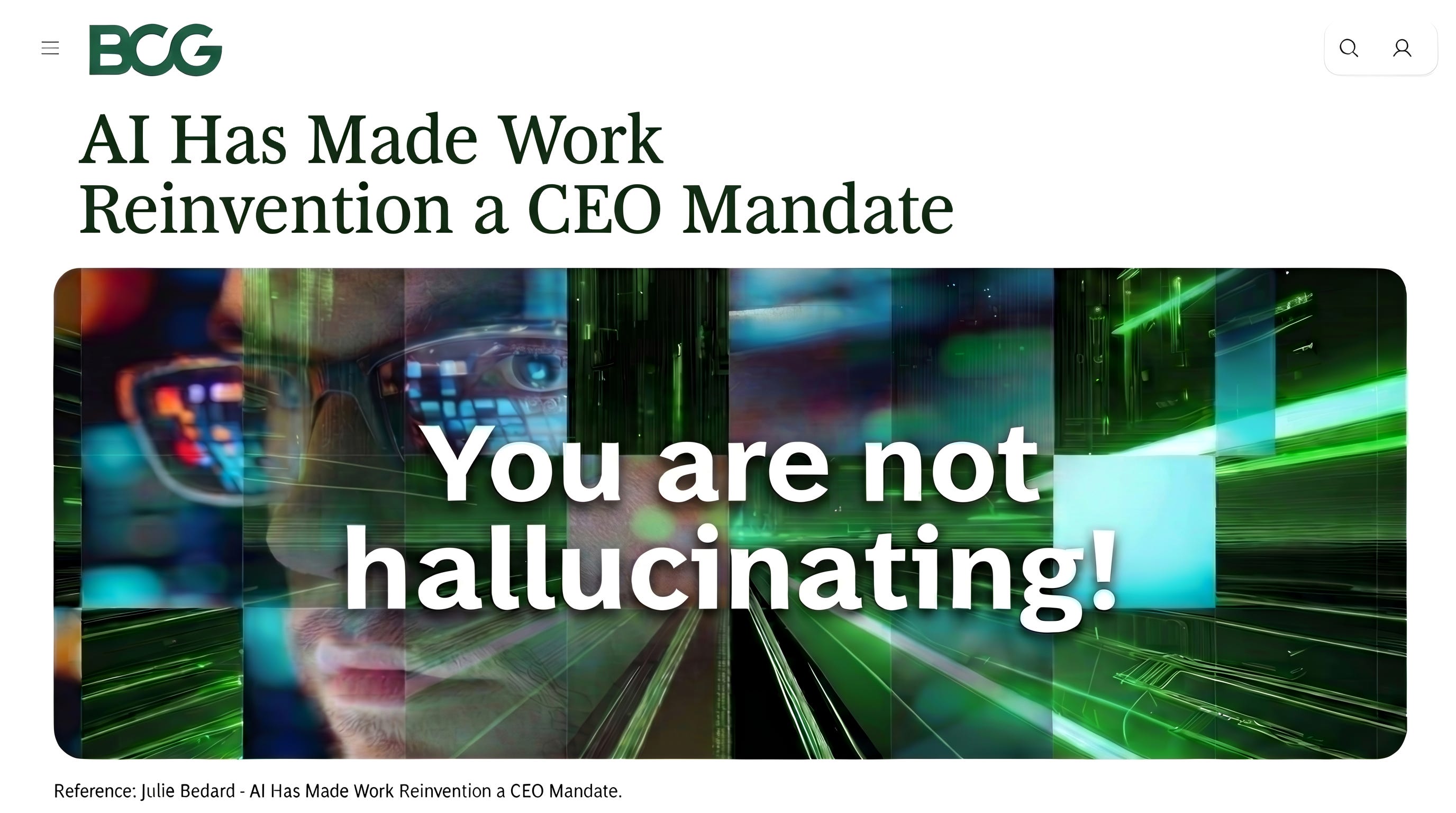
You are not hallucinating
What I quickly discovered was that I was not alone in my profound sense of displacement. Every senior executive I still speak to is carrying the exact same heavy question, usually in silence.
Am I still the right person for this?
Half of all CEOs believe their job depends on getting AI right. Only 15% are leading it decisively. Nearly one in three are not confident that the moves they are making today will secure their long-term legacy. The rest are performing confidence while privately wondering whether the world has already moved past them.
Saturday morning after breakfast. Coffee with your CFO. The sun coming in. You drive the vision. The CFO controls the tap. Neither of you says what both of you are thinking. You want to say: I am not hallucinating. This is real. Everything I built my career on is expiring. But you cannot — because the moment you show doubt, the succession conversation starts without you.
So, you smile. You finish your coffee. And you carry it alone.
This is not my story anymore. This is yours.
You are sitting in the chair I left. The cost of not deciding is not dramatic at first — but it is compound. Every month without clarity is a month spent in the wrong direction. The job title sounds impressive at dinner. The calendar is full. The regular paychecks keep coming in. But the prestige is leaking. The decisions that used to require your judgment are being made by others working with AI agents. The meetings that used to need your presence are being summarized before you arrive. You are still in the room — but the room no longer needs you the way it did.
Are you willing to confront that? Are you willing to make the call — to step aside, to reinvent yourself — before someone decides for you?
Go, fork yourself
Humanity is rapidly approaching a series of massive historical forks, and the first major divide is already wide open. Creators versus consumers. Some will pick up the tools and build. Others will watch. The gap is not rich versus poor. It is someone with exponential leverage versus someone without it.
I hear the counter-arguments every week. From CEOs, board members, accomplished professionals — all of them I sincerely respect. If AI takes the work, what is left? Universal High Income funding our existence — a nirvana that feels more like hell than heaven?
I understand the fear. But it rests on a false equation: that work equals purpose. It does not. It never did. Before industrialization, identity came from faith, family, craft, community. We narrowed it to a job title and a salary. AI is not taking your purpose. It is exposing how narrow that purpose had become.
A logistics manager whose job was automated discovered a dormant passion for astrophysics — now working with AI trained on decades of observational data, simulating the cosmos. He did not lose his purpose. He found a larger one his job never gave him room to explore. IKEA retrained 8,500 call center agents into interior design consultants — a billion-euro revenue stream, zero layoffs. They did not lose their jobs. They found better ones, closer to what they actually cared about.
Curiosity is the driver. The thing you would do if nobody paid you — that is the signal.
The question at every fork is the same one your career already forced on you: who do you want to be on the other side? There is new vocabulary forming — not rigid job descriptions, but vital roles. I would label three paths for the post-AGI era.
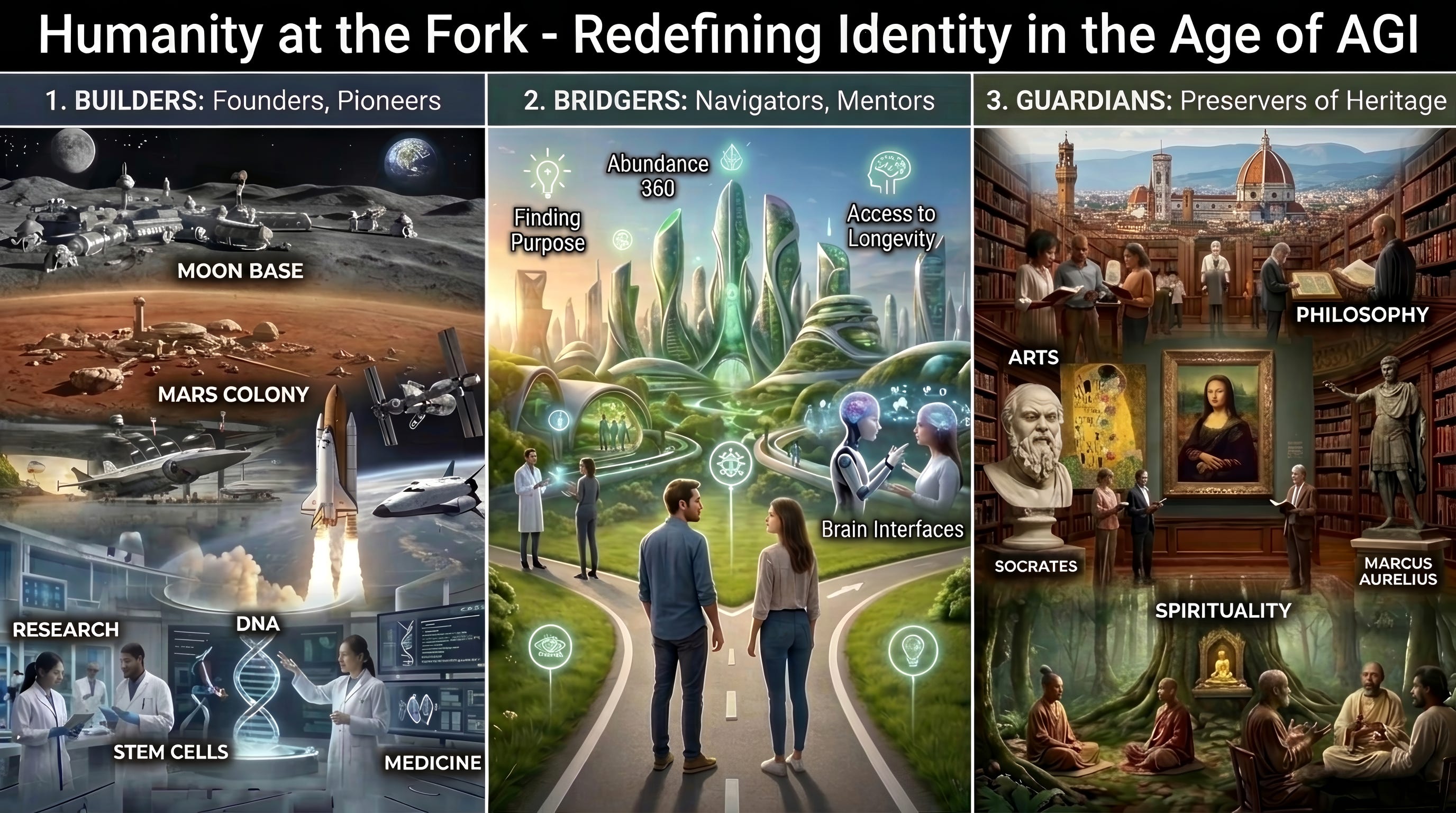
Builders, Bridgers, and Guardians
Builders are driven by relentless curiosity to explore the frontiers that intelligent machines make newly accessible. The market demands people who can get their hands dirty — prompt, design, iterate, ship. For a generation, seniority meant distance from the work: “I am a decision maker, not a worker.” That equation is collapsing. The suit I described burying a few paragraphs ago was not just a wardrobe change — it was the end of a leadership model built on authority by appearance. Hands-on is the new seniority. The leaders who will matter are the ones who build, not the ones who delegate from a distance.
Bridgers guide others from the old world to the new one. Bridging is exhausting, active, and critical work. The millions of displaced professionals do not need theorists who merely adapted to the changing times. They need people who built a crossing over the abyss and are standing on the other side saying: I know the way. I walked it. Come. Not all Bridgers will be founders. Some will coach. Some will redesign education. Some will build communities. Some will write the policies that make responsible transition enforceable. I want to thank two mentors who helped me cross the bridge from my old corporate self to my new one: Klaus Schmid and Krassi Hagedorn.
Guardians protect what truly matters. The teachings of Socrates and Marcus Aurelius. The paintings and sculptures of the Renaissance — visit Florence, and you will feel it. The spirituality of ancient traditions. The libraries of books and scriptures that shaped our progress. Guardians preserve the heritage that defines what it means to be human — so that the Builders and Bridgers never forget what they are building for.
Building for legacy
As Prometheus-X PRO gains traction, talented people reach out directly. Twice a week. CVs from young professionals and senior executives. I cannot answer every message. I cannot hire you all — not the way employment used to work. My invitation is different now. Not “come work for me.” But “let us build something together.” Exchange equity instead of salary. Bet on the outcome, not the paycheck.
I left the comfort of a guaranteed salary and a vesting stock plan for this. Not because the money did not matter. Because what it was buying — comfort without purpose — had stopped being enough. Legacy is not your bonus. It is not your vested stock. The only question that will matter at the end is whether you used what you had to make a difference — or whether you optimized for comfort and called it a career.
Steve Jobs paid himself $1 a year. Elon Musk earns $54,000. The era of building for salary is over. The era of building for legacy has begun.
Your purpose often sits next to the biggest pain you ever experienced. Viktor Frankl wrote that meaning cannot be found by chasing it — it emerges when you dedicate yourself to something larger than yourself. The leader who stops asking “How do I stay relevant?” and starts asking “What is worth building, which problem is worth solving, and who can I bring along?” — that leader completed the rites of passage.
Answering my own questions
I am a Builder by day and a Bridger by night. I build something new — and I build the bridge for others to cross what I walked across. For my daughter, I will be a Guardian. Always. Teaching what it means to trek the Himalayas, fly a propeller plane, or play basketball. The things no model can teach and no algorithm will replace.
If you recognized yourself in this article — I want to hear from you. Not to sell you something. To build something with you.
The singularity does not wait for your business plan. While we were discussing how to ship agents as a service, two Y Combinator startups already shipped their MVP. The future does not care about your timeline. Neither does your relevance.
Reclaim it. You are not alone.
Manfred Schadenhofer is Managing Partner and Co-Founder of Prometheus-X PRO. Fractional Chief AI Officer. After 20+ years advising boards and CEO-level steering committees on enterprise-scale transformation, he now helps leaders rewire for AGI-First — with responsible people transition as a non-negotiable standard. Contributing to a legacy beyond his lifetime.
Follow on [LinkedIn] | [Substack] | [Medium]
Sources
• Starcloud — first AI data center in orbit (November 2025)
• ARC-AGI-1 benchmark, François Chollet (arcprize.org)
• BCG CEO Insomnia Index: What (and Who) Is Keeping CEOs Up at Night? (April 2026)
• Julie Bedard, BCG — “You Are Not Hallucinating: AI Has Made Work Reinvention a CEO Mandate” (April 2026)
• Peter Diamandis — “Humanity Is About to Fork,” Metatrends (April 2026)
• Akram Awad — “Will AI Make Humans Useless?” TED at BCG, Dubai (November 2025)
• Viktor Frankl — Man’s Search for Meaning (1946)